All articles · Published 2026-09-12
British vs. American spelling: theatre is not a typo, it just lost to an 1828 dictionary
Several users have recently reported theatre and centre in our questions as misspellings. They are not. They are British spellings, every bit as correct as theater and center — they simply stand on the other side of the Atlantic. This is the first post in a new series, Language Notes: we start with a clean table of the most common -er / -re pairs, then work through -or / -our, -ize / -ise, single vs. double l and the rest, with a detour into how a man named Noah Webster split English in two with a dictionary that barely sold — and which of his proposals were laughed out of the room (tung, wimmen, soop). At the end, an honest answer to "which one does the TOEIC use?" We counted.
First, those reports
On August 10, a user tapped Report on a Part 3 option reading "At a theatre box office": "theater is misspelled, please fix." On August 21, a second report on the same word: "theater misspelled." On September 11, a third: "The second answer has a spelling error — it's center, not centre, thanks!"
All three were polite, and all three were wrong — but wrong in an entirely reasonable way. If your school textbooks, your dictionary app and your phone keyboard's autocorrect have all been American English for as long as you can remember, which describes most of our users, then a lifetime of center followed by a sudden centre reads like somebody's finger slipped.
Nobody's finger slipped. Theatre and centre are the standard spellings in Britain, Australia, New Zealand, Ireland, India, Singapore and most of the rest of the English-speaking world. Counted by country, far more of the English-speaking world treats theatre as standard than theater.
The purpose of this post is simple: the next time you meet -re, -our or -ise, you should not have to stop and question reality.
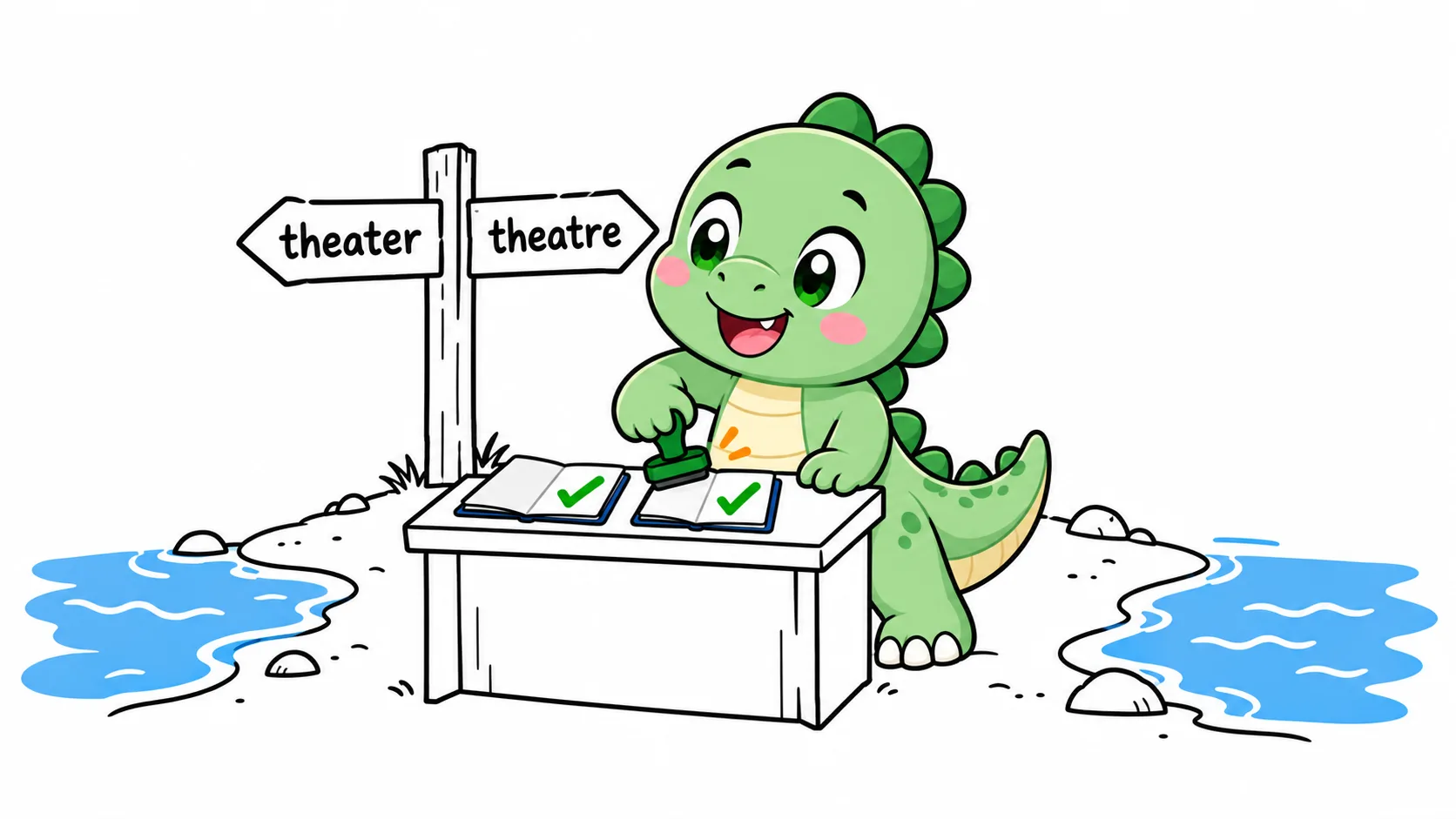
-er or -re? The common pairs
This is the group that draws the most reports, so it goes first. American on the left, British on the right:
| American | British | Meaning | Typical context |
|---|---|---|---|
| center | centre | center; shopping/conference center | shopping centre, conference centre |
| theater | theatre | theater; cinema | Part 3 and Part 4 location questions |
| meter | metre | the unit of length | specifications, distances |
| kilometer | kilometre | kilometer | distances |
| liter | litre | liter | volume specifications |
| fiber | fibre | fiber; fiber optics | product descriptions |
| caliber | calibre | caliber; quality | (rare) |
| maneuver | manoeuvre | maneuver | (rare) |
| somber | sombre | somber | (rare) |
| specter | spectre | specter | (rare) |
| luster | lustre | luster | (rare) |
| saber | sabre | saber | (rare) |
The rule is plain: American English flips the French-derived -re to -er; British English keeps -re. The first six are regulars in workplace English; the rest are rare, and listed only so you recognize them.
Two small landmines:
- British English uses meter too. British metre is the unit of length (and the rhythm of a poem). A measuring device — a parking meter, a gas meter — is a meter in London as well. So a British building notice that contains both metre and meter has not been badly proofread.
- A few -re words never flip: acre, massacre, mediocre, ogre. Change the ending to -er and the c of acre, massacre and mediocre (or the g of ogre) would take on the wrong sound (acer would be read "ay-ser"). On these words Americans chose pronunciation over principle.
Incidentally, on Broadway the marquees mostly say Theatre. Americans, too, find -re a little classier.

The Booth Theatre on Broadway: the carved facade and the awning both use -re. Photo: Ajay Suresh, CC BY 2.0, via Wikimedia Commons.
.jpg)
Why are there two systems? 1755 versus 1828
Before the eighteenth century, English spelling was fairly relaxed; several spellings of one word coexisting was normal. What pinned it down was two dictionaries — with opposite convictions.
The first came in 1755: Samuel Johnson's A Dictionary of the English Language, published in London. Johnson respected etymology, so words that came from French kept their French look: centre, theatre, colour, honour. From then on British spelling had a recognized answer key.
The second came in 1828: Noah Webster's An American Dictionary of the English Language, seventy thousand entries, twelve thousand of them never before recorded in a dictionary. The spellings themselves were not new in 1828 — his 1806 Compendious Dictionary already used them; the 1828 volume settled them and put them in a seventy-thousand-entry reference. Webster had strong opinions. A new nation should have its own language, spelling should follow sound, and no one should keep colonial-era surplus letters around for the sake of the French. So he changed things:
- -re became -er: centre → center, theatre → theater
- -our became -or: colour → color, honour → honor
- -ce became -se: defence → defense, offence → offense
- the surplus k was cut: musick → music, publick → public
- the past tense stopped doubling l: travelled → traveled, cancelled → canceled
The changes stuck less because of the dictionary than because of a spelling textbook he had published in 1783, known as the Blue-Backed Speller. It sold fifteen million copies by 1837 and sixty million by 1890 — whole generations of American schoolchildren learned to write from Webster's spellings. The 1828 dictionary, by contrast, had a first printing of 2,500 copies that had still not sold out thirteen years later, and at 82 he had to mortgage his house to bring out the 1841 second edition.
Webster did not win everything: tung, wimmen and soop
Worth knowing: Webster wanted to change far more than this. He believed spelling should follow pronunciation, so in his 1806 Compendious Dictionary the entry for women reads —
Wimmen, n. pl. of wimman, the old and true spelling.
By 1828 he had given up on wimmen, but on tongue he held the line to the end; the dictionary states flatly, "Our common orthography is incorrect; the true spelling is tung." He also argued that soup should be soop (it rhymes with hoop and loop, after all), blood should be blud, and daughter should be dawter.
None of these succeeded. The American public accepted color and center, then turned and walked away from tung and wimmen as one. Today's American spelling is therefore the wreckage of a spelling reform that popular opinion cut off halfway — it is not more "logical" than British spelling; it just happens to have stopped where it stopped.
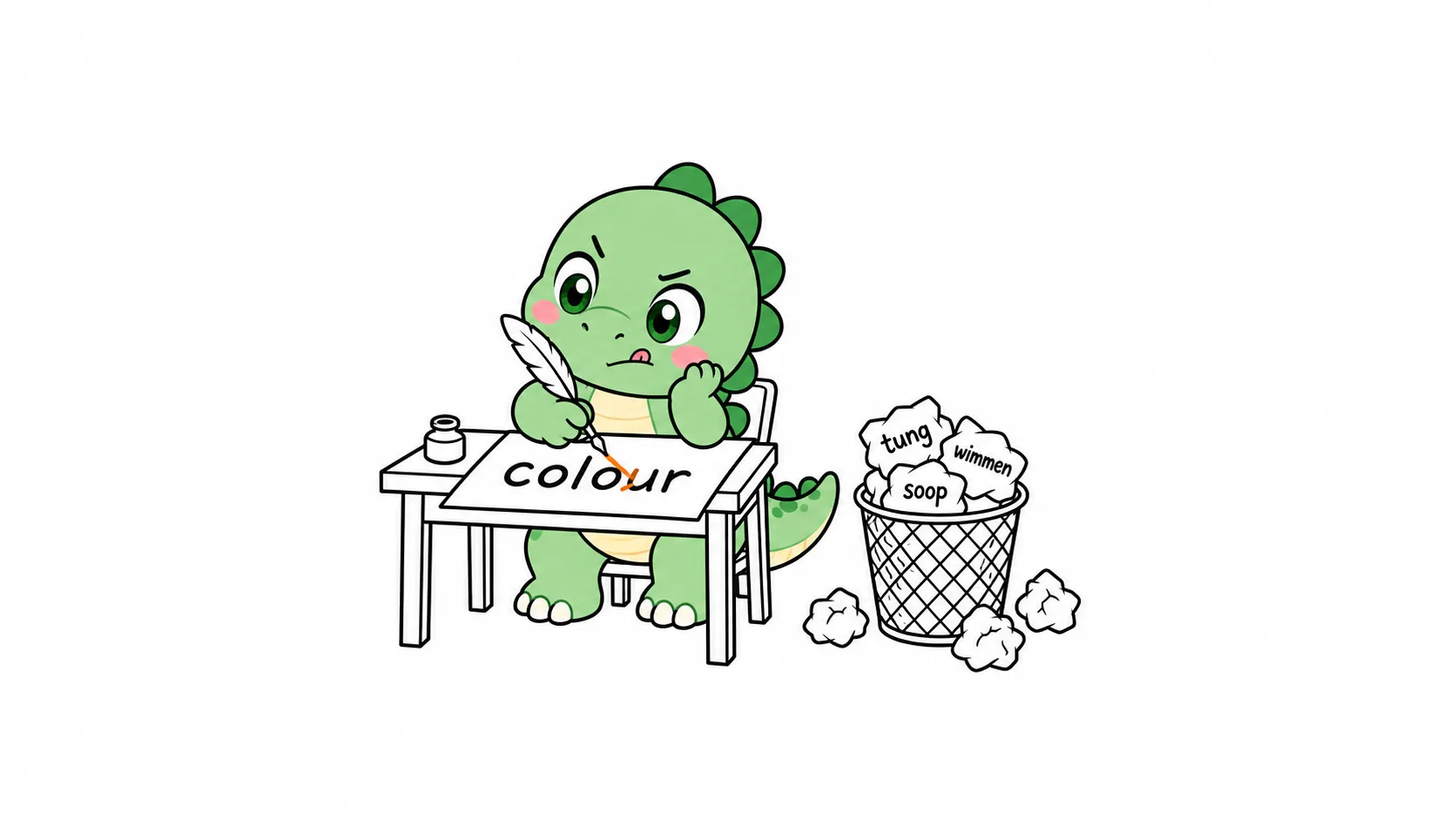
Once you see that, the question "which one is correct?" evaporates on its own. Both are choices that dictionary-makers made, then frozen in place by tens of millions of textbooks.
The other common differences, grouped
-er / -re is the tip of the iceberg. Below, grouped by rule, are only the words that actually turn up in TOEIC settings.
-or / -our
| American | British |
|---|---|
| color | colour |
| favor / favorite | favour / favourite |
| labor | labour |
| honor | honour |
| behavior | behaviour |
| neighbor / neighborhood | neighbour / neighbourhood |
| humor | humour |
| flavor | flavour |
| harbor | harbour |
| rumor | rumour |
| endeavor | endeavour |
One exception: glamour is glamour in America too (though the adjective is glamorous). And there is an Australian political party called the Australian Labor Party, spelled the American way, thanks to the influence of the American labor movement in the early twentieth century. If Australians cannot agree with themselves, you need not be too hard on yourself.

The magazine spells it for you: this is the US edition of Glamour, 2025, and the masthead keeps its -our. Cover © Condé Nast, shown here to illustrate the spelling.
-ize / -ise and -yze / -yse
| American | British |
|---|---|
| organize / organization | organise / organisation |
| realize | realise |
| recognize | recognise |
| apologize | apologise |
| analyze | analyse |
| paralyze | paralyse |
This group carries a fact that is usually told backwards: -ize is the older form. It has been in use in Britain since the fifteenth century, more than a century before -ise, which spread later under French influence. Oxford University Press still insists on -ize (so-called Oxford spelling, affecting roughly two hundred verbs) on the grounds that it is closer to the Greek suffix -ίζω. The Times of London did not switch to -ise until 1992. So organize in a British text is not a mix-up; it is the Oxford camp.
Separately, a group of words takes -ise on both sides of the Atlantic and can never take -ize: advertise, surprise, exercise, compromise, supervise, advise. They are not members of the Greek -ize family.
-og / -ogue
| American | British |
|---|---|
| catalog | catalogue |
| dialog | dialogue |
| analog | analogue |
American usage actually runs both ways here (dialogue is more common than dialog in American prose), so this is the most forgiving group.
-ense / -ence, and the noun–verb split
| American | British |
|---|---|
| defense | defence |
| offense | offence |
| pretense | pretence |
| license (noun and verb) | licence (noun) / license (verb) |
| practice (noun and verb) | practice (noun) / practise (verb) |
The last two rows are a British-only rule: c for the noun, s for the verb — a driving licence, to license a product; daily practice, to practise the piano. American English uses license and practice for both. So when practise appears in a British-flavored Part 5 sentence, it must be a verb — a free clue.
Single l or double l
| American | British |
|---|---|
| traveled / traveling | travelled / travelling |
| canceled | cancelled |
| labeled | labelled |
| modeling | modelling |
| counselor | counsellor |
| jewelry | jewellery |
The rule: for verbs ending in -l where the stress is not on the last syllable, British English doubles the l before a vowel-initial suffix (-ed, -ing, -er); American English does not. (Third-person travels has one l on both sides; and cancelled is in fact common in America too — another battle Webster never quite won.)
Annoyingly, one set runs the other way — single l in British, double in American:
| American | British |
|---|---|
| enroll / enrollment | enrol / enrolment |
| fulfill / fulfillment | fulfil / fulfilment |
| skillful | skilful |
| installment | instalment |
An enrolment in a Part 7 course-registration email is not missing a letter.
Keeping or dropping the e
| American | British |
|---|---|
| judgment | judgement |
| acknowledgment | acknowledgement |
| aging | ageing |
(British courts, however, write judgment. Both sides always have one more exception than rule.)
ae / oe
| American | British |
|---|---|
| encyclopedia | encyclopaedia (encyclopedia is now the usual British form too) |
| pediatric | paediatric |
| medieval | mediaeval (medieval is now the usual British form too) |
| maneuver | manoeuvre |
| estrogen | oestrogen |
Words that barely look related
No rule here; these you simply learn:
| American | British | TOEIC setting |
|---|---|---|
| check | cheque | payment methods, invoices (only the money check becomes cheque; the inspect check is the same on both sides) |
| program | programme | event programs, training courses (but a computer program is program in Britain too) |
| tire | tyre | car servicing, repairs |
| curb | kerb | the roadside (the verb curb, "to restrain", is the same on both sides) |
| story | storey | a floor of a building (a tale is a story everywhere) |
| gray | grey | colors |
| mold | mould | molds; mildew |
| draft | draught | draft beer, a draft of air (a draft document is draft in Britain too) |
| aluminum | aluminium | material specifications |
| inquiry | enquiry | customer enquiries |
| math | maths | the school subject |
| airplane | aeroplane | travel |
| pajamas | pyjamas | almost never, but too charming to leave out |
The parenthetical "same on both sides" notes matter: British English does not turn every check into a cheque, only the one you pay with.
Which one does the TOEIC use? We counted
Start with what the official documents say clearly. When the TOEIC was redesigned in 2006, ETS wrote in its own technical report that the old Listening section had used only standard American accents, and that the new one varied them "because the TOEIC test is a test of international English, and examinees are likely to need to communicate with a variety of English speakers." The four voices in the small-scale prototype were a US woman, a British woman, a Canadian man and an Australian man (ETS, TOEIC Compendium, TC-10-02, 2010). That much is on the record.
On spelling in the Reading section, ETS has published no policy. So we did something rather crude: we downloaded the official TOEIC Listening & Reading sample test from the ETS website and counted it word by word, audio script included — and including two advertisements that are embedded as images, which plain text extraction skips (our first pass missed exactly that, and a reviewer caught it). Plurals count; ETS's own copyright page does not.
The result: color 14 times, program 4, center 2, catalog 2, the organize family 2, favorite 1, gray 2, tire 2. British spellings: zero.
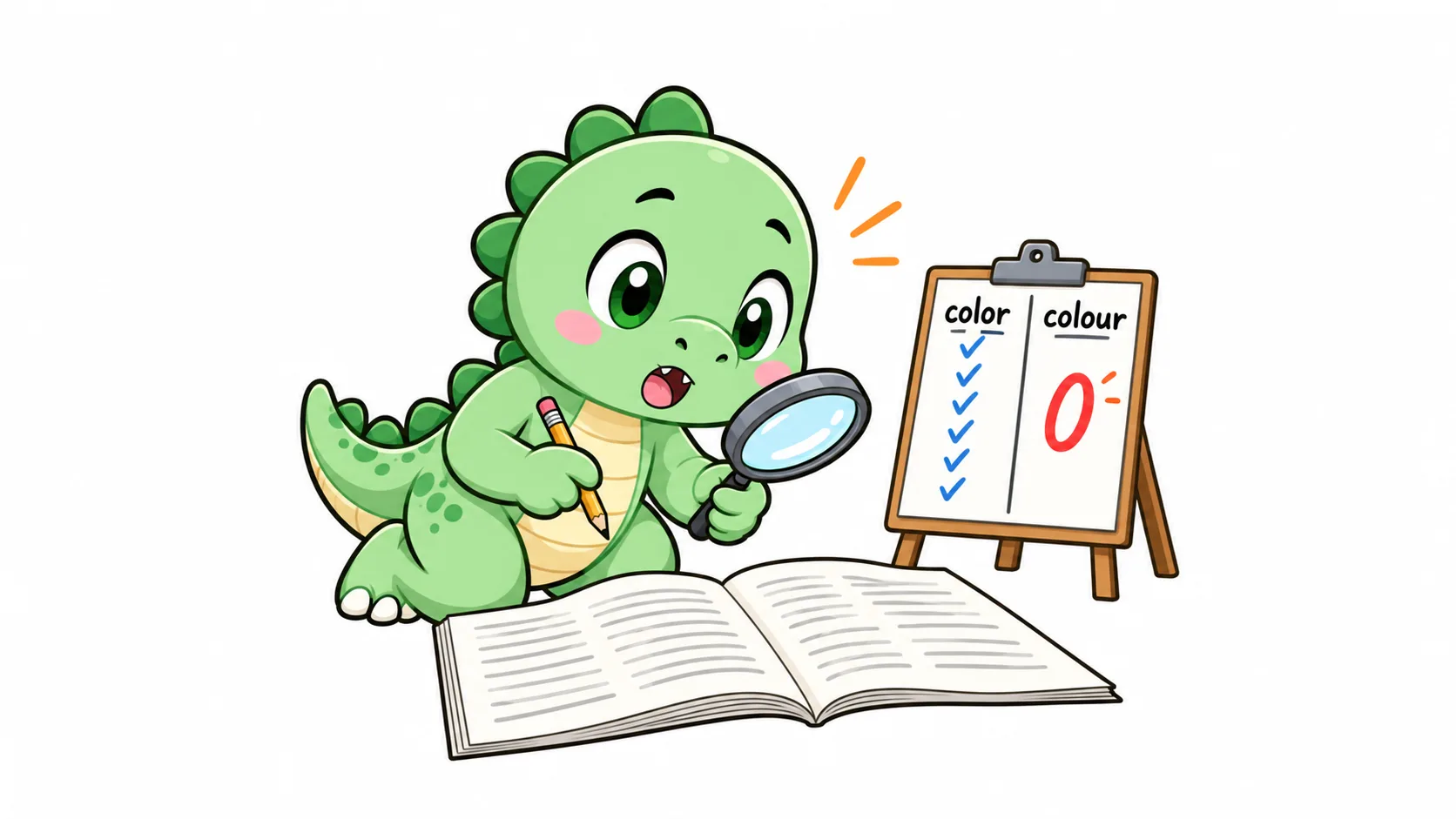
In other words, judging by the one sample ETS itself publishes, the written questions are in American spelling. Whether real test forms set in London or Sydney switch to local spelling is a matter of much prep-book lore, but we have no official statistics and are not going to make promises on ETS's behalf.
And our own question bank? We counted that too. Across the current Reading and Listening banks, center appears 592 times and centre 235; theater 47 times and theatre 34. Summing 48 word pairs that have two spellings, American forms appear 5,802 times and British 1,858 — roughly one in four is British.
That ratio is not an accident; it is a choice, for two reasons. First, the TOEIC simulates an international workplace, and real workplace English is mixed: the memo from the London branch says programme, the quote from the Sydney supplier says colour, the colleague in Toronto writes centre but also tire. You stop stumbling once you have seen enough of it. Second, and more practical: recognizing both spellings costs nothing, and not recognizing them costs two seconds of self-doubt in the exam room. In a 75-minute, 100-question Reading section, two seconds is a luxury.
Which one should I use myself?
The TOEIC Listening & Reading test does not ask you to write a single word, so as far as this exam goes: you do not have to choose, only to recognize.
For work or writing, pick one and stay consistent from the first line to the last. If your default is American, as it is for most of our readers, that is perfectly fine. The only thing that genuinely loses points is color and colour alternating within one document — that is not cosmopolitan, that is unproofread.
Which of the above not to take on faith
Tidy tables do not mean the world is tidy.
This is not a clean binary. Canada writes colour and centre but tire and curb; Australia mostly follows Britain yet reaches for program more readily than programme; Oxford University Press insists in Britain on the -ize that Americans use; New York theaters hang signs reading Theatre; British courts write judgment. Every table above has exceptions, and the exceptions drift over time. We listed "usually", not "always".
We cannot prove that British spellings appear on real test forms. The official sample test has none — we counted by hand; for live tests we have no data. Take this post as "recognizing them does no harm", not as "the TOEIC will test this".
The app's handling of British spellings is still incomplete. The vocabulary lexicon currently holds 3,834 headwords, of which 91 record a British variant — long-press theatre in a question and you get the theater card, by design. But if you long-press a British spelling and nothing comes up, that is a genuine defect. Please report it and we will fill the gap.
Finally, back to those three reports. Thank you to everyone who taps Report — it means you are reading every single letter, which is precisely the skill a reading test measures. Just this once, the error was not in the question. It was that the man who mortgaged his house for a dictionary did not win quite thoroughly enough.
Long-press any word in a Handy 990 question to look it up; British spellings resolve to the same card automatically. Language Notes is a new series about English itself rather than the app — the next topic is undecided, and the in-app feedback form is always open if there is something you want explained. On why we do not ask you to learn phonetic symbols, read It's 2026. Why Are We Still Memorizing Phonetic Symbols?.