All articles · Published 2026-11-05
How to Choose an English Name: What Candy, Bambi and Kiki Sound Like to Native Speakers
How do you pick an English name without embarrassing yourself? Candy, Bambi and Cherry sound sweet in much of Asia, but to many Americans they sound like a stripper's stage name, and doubled names like Kiki and Gigi read as nicknames. Men's names have traps too: Columbus carries a history of enslaving Indigenous people, and almost nobody has named a baby Adolf since 1945. Using US Social Security baby-name records, this post explains where those associations come from and what to check before you choose.
Where did your English name come from?
Across East and Southeast Asia, plenty of people got their English name on the first day of English class. The teacher read out a list, or you picked something you liked: the heroine of the anime Candy Candy is Candy, the young witch in Miyazaki's Kiki's Delivery Service is Kiki, and the Hong Kong singer Gigi Leung goes by Gigi.
Where these names come from, they are completely innocent. Candy is an orphan girl; Kiki is a thirteen-year-old witch who delivers parcels.
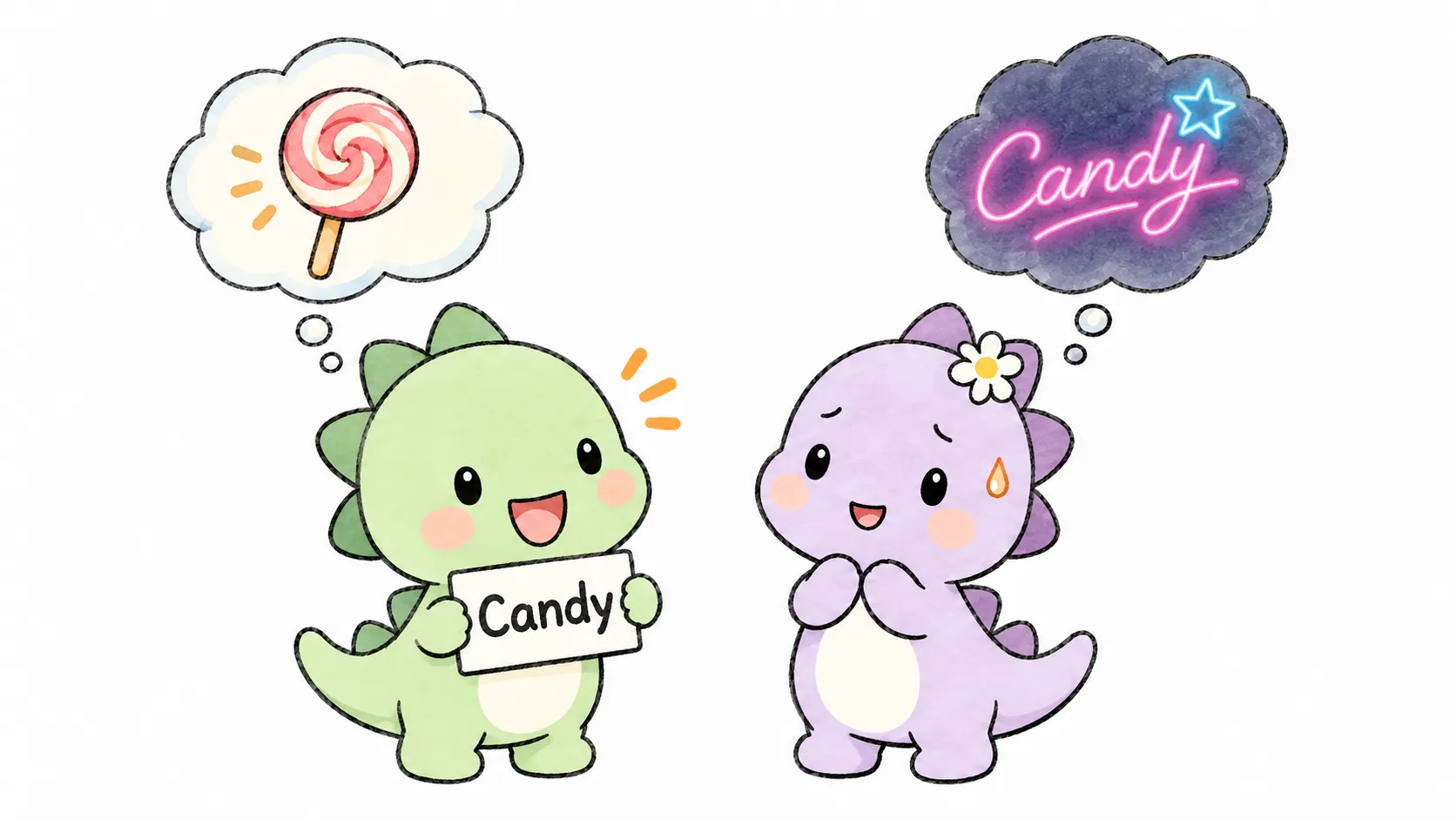
The catch is that a name doesn't mean what you meant by it. It means what the listener hears. When a native English speaker hears "Candy," a 1970s Japanese cartoon is not what comes to mind.
Why do Candy and Bambi sound like stripper names?
English has a well-worn stereotype called the stripper name. When Americans joke that "that sounds like a stripper name," they mean a fairly fixed set of names:
| Type | Examples |
|---|---|
| Sweets | Candy, Cherry, Honey, Sugar |
| Small animals | Bambi, Bunny |
| Gems and sparkly things | Diamond, Crystal, Star |
| Words that sound like wishes | Destiny, Angel |
These are stage names. The sociologist Bernadette Barton, who interviewed exotic dancers in the US, describes how dancers deliberately build a stage persona kept apart from their real selves, and the stage name is part of that persona (2007, Journal of Contemporary Ethnography). A persona doesn't need a name that sounds real. Sweet, soft, small and edible: you can tell straight away that the name was picked for a role.
A few of these names carry more specific baggage:
- Bambi started as the fawn in Disney's 1942 film. But the star of Debbie Does Dallas (1978), one of the best-known adult films in America, went by the name Bambi Woods.
- Candy is sugar, but it is also the title and heroine of a 1958 erotic satirical novel by Terry Southern and Mason Hoffenberg.
- Gigi is a 1944 novella by the French writer Colette about a girl raised by her family to become a high-class courtesan; it was later made into a musical film.
Do Americans still give their babies these names?
This part we can check with numbers. The US Social Security Administration (SSA) publishes yearly counts of baby names, leaving out any name given to fewer than 5 babies. We looked up a few of these names (the data run to 2017):
| Name | Peak year | Baby girls that year | 2017 |
|---|---|---|---|
| Candy | 1970 | 1,044 | 45 |
| Bambi | 1979 | 327 | 7 |
| Cherry | 1947 | 354 | 26 |
| Kiki | 1975 | 42 | 12 |
| Gigi | 1962 | 271 | 56 |
By 2000, only 5 baby girls were named Bambi. The US has roughly 1.8 million baby girls a year, and these five names together came to fewer than 150 of them in 2017.
That is the heart of the problem. When American parents have mostly stopped giving a name, a listener who meets an adult woman with that name will guess that she chose it herself. And the most familiar place for a self-chosen, sugary name is a stage.
So when a Candy from Taipei introduces herself at an international conference, the person across the table won't necessarily think anything of it, but the split second of association in their head is not something she can control.
Teachers who hand out these names
This section is my own opinion.
A lot of Candys, Bambis and Cherrys didn't choose their names. An English teacher at school or a cram school gave it to them. Those teachers may speak excellent English, with flawless grammar and pronunciation, but handing out stripper names to little girls one by one shows that what they know is the English language, not the culture of the people who speak it.
Language and culture are two different things. A dictionary will tell you that candy means sweets. It won't tell you what an American thinks when an adult woman introduces herself as Candy. You only learn that by living in the culture and hearing the jokes.
If you teach English, ask a native-speaker friend before you name a student. The student will carry that name for years, quite possibly onto a résumé, a business card and the first email to a client overseas.
What's wrong with doubled names like Kiki and Gigi?
To be fair, Kiki and Gigi aren't classic stripper names. The supermodel Gigi Hadid is called Gigi.
The problem with doubled names is milder and different. In English, a name that repeats one syllable is almost always a nickname. Gigi can be short for Georgina or Gisele, Kiki for Kristina, and the same goes for Lulu, Coco and Fifi. There's nothing wrong with a nickname; friends use them all the time.
But a nickname printed on a business card or a résumé works a bit like signing a cover letter with your childhood nickname: not wrong, just not the voice of someone about to talk business. If you like Kiki, consider a full name such as Kristina at work and keep Kiki for friends.
Do names really change how people see you?
Some research suggests so, but read it carefully.
The economists Bentley Coffey and Patrick McLaughlin matched South Carolina's bar records with voter registration lists (2009, American Law and Economics Review) and found that the more gender-neutral or masculine a woman lawyer's name sounded (Cameron, Kelly), the likelier she was to become a judge. The authors themselves say they don't know why.
That is one state, one profession and one correlation. It doesn't mean "you'll never get promoted if your name is Candy." It shows something smaller: a name speaks for you before anyone has met you.
What should men watch out for in an English name?
Men's names rarely have the "too sweet" problem, but they have a different trap: a famous person standing behind the name.
Columbus. In many Asian textbooks, Columbus is the explorer who discovered the New World. In today's United States his image is very different. In 1495, on Hispaniola (today's Haiti and Dominican Republic), Columbus rounded up about 1,500 Taíno people and picked about 500 to ship to Spain for sale; roughly 200 died during the crossing (the figures vary by source). Many US states and cities have renamed Columbus Day in October as Indigenous Peoples' Day or added that holiday alongside it, and on October 8, 2021, Joe Biden issued the first presidential proclamation of Indigenous Peoples' Day.
In 1922, 187 American baby boys were named Columbus. In 2017, there were 5.
Adolf / Adolph. This is Hitler's first name. In 1917, 673 American baby boys were named Adolph; in 2017 there were 6. The German spelling, Adolf, has fallen below 5 babies a year since 2000, so it no longer appears in the SSA list at all. In Germany, the name also all but disappeared after 1945.
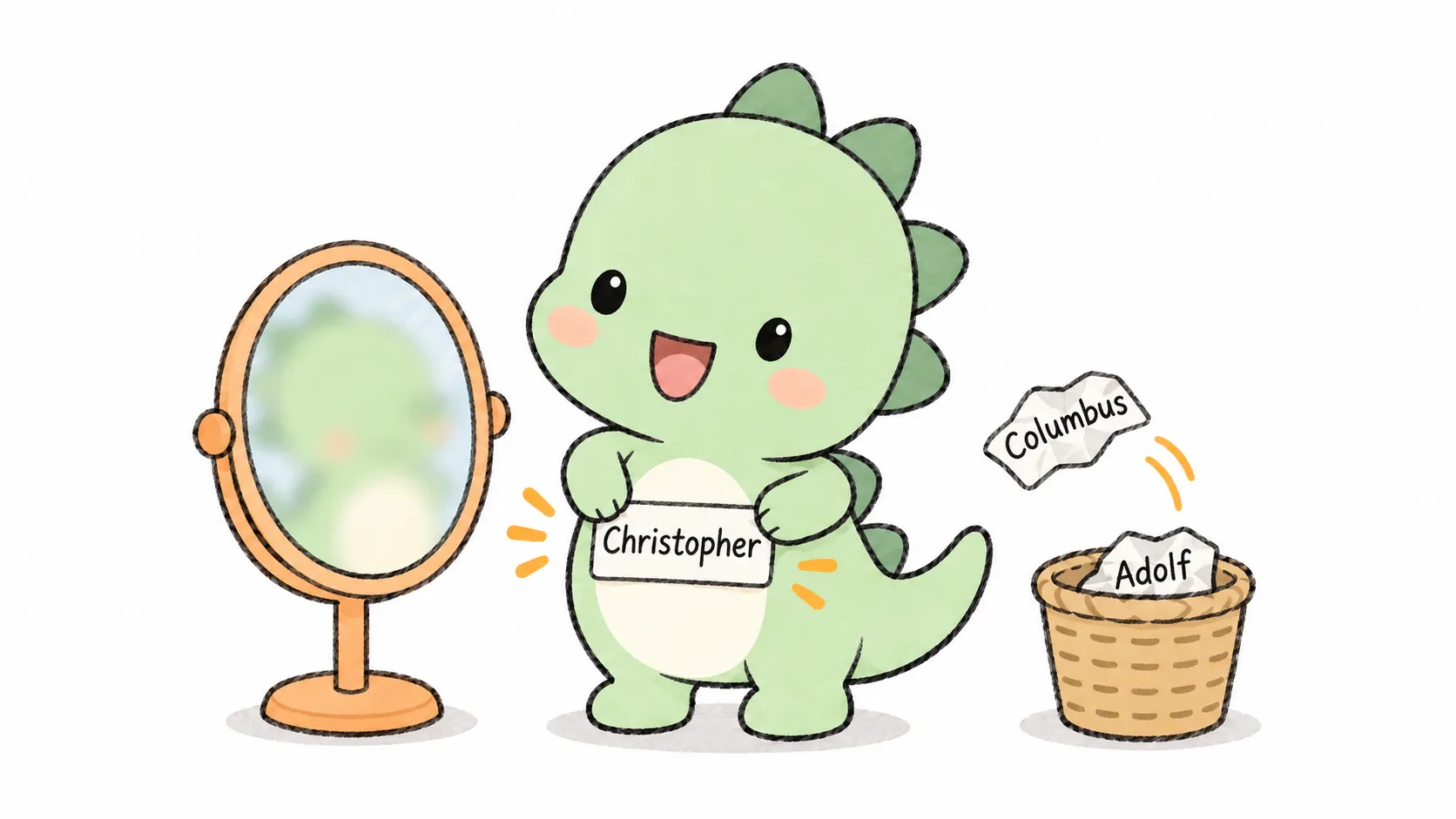
The pattern in both cases: the name itself did nothing wrong; its most famous bearer made it unusable. Christopher, Columbus's first name, is still a perfectly ordinary name today. The trouble is using the surname Columbus as a first name, because it points to only one man. Before you pick a name, ask: when people hear this name, who do they think of first?
Some names sound different in Britain and America
The last kind of trap is slang, and it differs across the Atlantic:
| Name | Short for | What people may hear |
|---|---|---|
| Dick | Richard | In both the US and the UK, an insult and slang for the penis |
| Randy | Randall | In British and Australian slang: sexually eager |
| Willy | William | British slang for the penis |
| Fanny | Frances | In Britain and Australia, the female genitals; in the US, the buttocks |
In 1934, 1,131 American baby boys were named Dick; in 2017, fewer than 5. America's Richards long ago switched to Rick or Rich. Randy goes the other way: 381 American baby boys still got the name in 2017, but the same Randy who moves to London may have to sit through the same joke every day. For more words that change meaning across the Atlantic, see British vs. American vocabulary.
Three things to do before you pick an English name
- Say it to a native speaker and watch their face. This beats any list. If they smile and then suppress it, pick another.
- Check whether Americans still give the name. The SSA website shows how many babies got any name each year. A name that plenty of parents still choose is usually an ordinary name.
- Search the name once and see who's on the first page. If the first page is all one historical figure, or all things you don't want your name tied to, you have your answer.
There's also a fourth option: skip the English name and use your own. Wei-Ming and Li-Ling work perfectly well in English, as long as people can tell which part is your given name and which is your family name. We covered that in How to address people in English emails.
Not everyone hears it this way
Everything above describes tendencies, not rules:
- Real people named Candy do just fine. CNN's longtime political correspondent Candy Crowley moderated a US presidential debate. Plenty of American women in their fifties and sixties are named Candy; they were born in the 1960s and 70s, when it was an ordinary name. The association attaches to the young, self-chosen case.
- "Stripper name" is a cultural stereotype, not a statistic. We found no study that actually counts dancers' stage names. The categories above come from common English usage plus the SSA naming data.
- The SSA figures cover only the US. Naming habits in Britain, Australia and Canada aren't identical, as Randy and Fanny show.
- Associations change. In 1979, 327 American baby girls were still named Bambi, though Debbie Does Dallas came out in 1978. A name's reputation doesn't turn overnight, and it can slowly recover.
- The Coffey and McLaughlin study shows a correlation. It can't prove the name is the cause.
Conclusion: a name is for other people to say
When we pick an English name, the natural question is "is this name cute?" But a name exists mostly for other people to say, so the better question is: "What will a native English speaker who has never met me think of when they hear it?"
Candy Candy is adorable, and so is Kiki. But the client at that international conference never watched Candy Candy as a kid. Chances are they have heard the joke "that sounds like a stripper name."
In Handy 990's Part 7 practice, English names are everywhere in the emails, memos and letters, and the questions often refer to the same person as Mr. or Ms. plus a family name. In this series, How to address people in English emails covers how to write your own name and English name in an email, and British vs. American vocabulary covers words that mean different things on each side of the Atlantic.