All articles · Published 2026-08-11
How *Not* to Emotionally Blackmail Your Users — a Breakup Notice from a Duolingo Veteran
Duolingo has turned emotional blackmail — that's the term the internet itself settled on — into a business triumph, marching tens of millions of people back into the app every single day. I'm a 2,871-day-streak heavy user and long-time paying subscriber, so this isn't an outsider's cheap shot; it's first-hand testimony from a victim. This article looks at how the tactics work, why "it works" doesn't mean "it's right," and why Handy 990 chose to go the other way — we may even remove streaks entirely.
First, my credentials
Let me confess up front: I'm not someone who quit after three days and came back to write an angry review. As of the day I'm writing this, my Duolingo streak stands at 2,871 days — nearly eight years without missing a single day, with a paid subscription running for most of them. Badge attached as evidence:
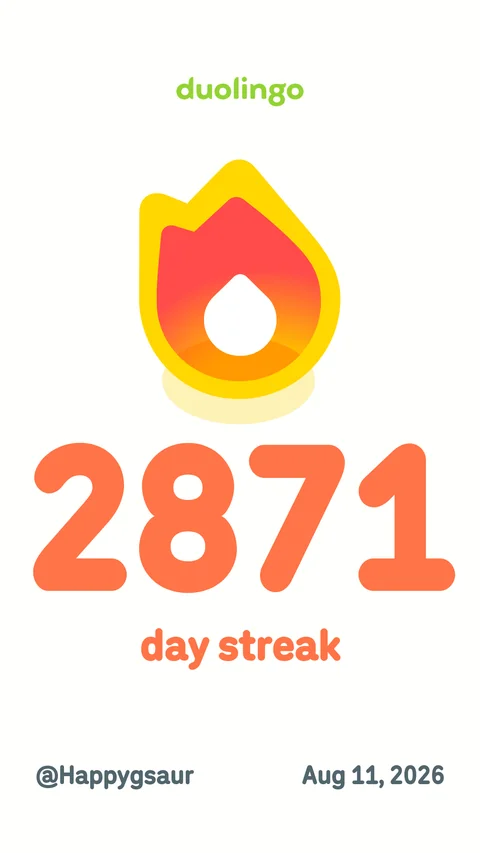
2,871 days. In a moment you'll see why this number deserves no envy.
I'm not hanging this number here to brag — quite the opposite. It's Exhibit A. As you'll see below, a good share of those days involved no learning at all; they were just days spent feeding the bird.
Textbook emotional blackmail
Google "Duolingo emotional blackmail" and the full playbook assembles itself:
- Streak counts: turn "did you open the app today" into a number that can die. The bigger it grows, the more terrified you are of losing it — the pressure comes from the number, not from learning.
- Escalating notifications: from gentle nudges all the way up to "the owl is disappointed in you" and "your language skills are getting moldy" — personal attacks, basically.
- Visual guilt trips: ignore the app for a few days and the owl on your home screen grows older, sadder, and eventually starts melting.
- Loss aversion: behavioral economics says losing something hurts far more than gaining it feels good. Duolingo weaponizes this — first it hands you virtual progress, badges, and rankings, then it threatens to take them away.
Not an accident — a calculated strategy
If you'd like to believe this is all an innocent design quirk, Business Insider's 2024 exposé will cure you of that:
- The copy is written that way on purpose. Break your streak and the phone reminders read "🥺It's been three days…" or taunt you with "looks like you've learned how to say 'quitter.'"
- The melting icon is not an urban legend. Parents in the article report children crying at the sight of that ever-more-wretched owl face.
- The most damning item: a Duolingo spokesperson admitted they measured it — drop the guilt-trip notifications and re-engagement falls by 5 to 8 percent. In other words, they know it's emotional blackmail, they've quantified exactly what the blackmail is worth, and they've decided to keep blackmailing.
- And the returns are handsome. When Business Insider wrote its piece in mid-2024, daily active users had just passed 31 million; by the Q2 2026 earnings report, that number had nearly doubled to 58.7 million, with 12.7 million paying subscribers. Better yet, part of that quarter's growth came from a one-time "Streak Revival" campaign — letting lapsed users resurrect their dead streaks — which won back over 15 million people. Notice: even the bait used to win you back is that same number. Marketing experts say Gen Z eats up this "brand as a person with attitude" act — even when the attitude is "jerk."
- Not everyone is amused. Redditors have flatly labeled the strategy emotional blackmail, and commenters under a Duolingo executive's post asked what kind of education runs on shame and guilt.
Heart surgery, and a number held hostage
There are cases more absurd than children scared to tears by an owl. More than one story has circulated online of someone who survived heart bypass surgery — and whose first act after leaving the hospital was writing to Duolingo, pleading to get their streak back, because it had been interrupted by a minor inconvenience like almost dying.
When a learning tool gets people fresh out of cardiac surgery worrying about a virtual number before their own heart, that's no longer "great gamification." That's unhealthy.
So is emotional blackmail a necessary evil?
Someone will surely argue: learning a language is a good thing, so what's wrong with a little pressure to push people toward it?
My answer is a capital-letter NO. There are many reasons; here are the two fatal ones.
First, it steals your intrinsic motivation. Mastering a language, watching a film without subtitles, holding your own in a meeting with overseas colleagues — these achievements are joyful in themselves. You don't need drugs to feel happy, and by the same token you don't need a bird's threats to sit down and study. Gentle reminders are fine; manufacturing a "precious" virtual asset and then holding it hostage is something else entirely. Psychology has said it for decades: once external carrots and sticks take over, intrinsic motivation withers. The day the bird is gone, you can no longer remember why you were learning at all.
Second, saving a streak and learning something are simply not the same activity. My own case: I subscribed to Duolingo to learn Spanish. But on countless nights, minutes before midnight with the streak about to die, what did my survival instinct reach for? French (which I studied for years and can pass half-asleep), chess, even calculus — anything that would log a "practiced today." Time spent, number saved, Spanish not one word better. The studying you do to save a streak is, almost by definition, exactly the studying you least need.
Our approach: put the streak back in its place
Handy 990 has a streak counter too. But we deliberately make no fuss about it: no melting icons, no midnight notification barrages, no "you've let me down." Honestly, we've had serious internal discussions about removing it altogether.
The reason goes back to what this app is for: converting your fragmented minutes into real English ability. If a mechanic drives you, late at night, to do the easiest things on the menu — a few Part 1 or Part 5 questions, two taps on grammar you mastered long ago — just to keep a number from resetting, then we're not helping you use your time; we're helping you waste it. That's also why we put our effort into features like study-direction recommendations: telling you what to practice now for the most progress, rather than insisting you open the app today no matter what.
A streak should be a by-product of learning, not its purpose. Reverse that order, and the tool becomes the master.
Don't be a victim
Learning is inherently fun and fulfilling. You study English because you want to — the raise, the trip abroad, the show watched without subtitles — not because a cartoon owl will be sad.
So don't be a victim of emotional blackmail. Gentle reminders: provided. Guilt: not in stock.
As for me — this is the year I actually cancel my Duolingo subscription. I mean it this time. Because compared with disappointing a bird, disappointing yourself is the real loss.