
All articles · Published 2026-11-10
Chunk Listening: for when you hear every word and still lose the sentence
The worst moment in TOEIC listening isn't an unknown word. It's hearing every word, more or less, and still having no idea what the sentence said. The clip ends, your mind is blank, and you pick an answer on feel. This usually isn't a vocabulary problem, and it isn't a concentration problem. Short-term memory is just small, and if you take a sentence one word at a time it is full before the sentence is over. Chunk Listening, a new BETA practice in Handy 990, trains the other way of hearing: cut a long stream of sound into a few pieces that carry meaning, understand them one at a time, then hear the whole sentence without pauses and put it back together. This post covers the three lines of research behind it, and what it can and can't do.
Listening is really two skills
The first is hearing the sounds: pronunciation, linking, intonation. Can you catch the sound accurately?
The second is getting the meaning: at the moment you hear it, do you know what it says?
Most people are stuck on the second one. We spend a lot of time on pronunciation and dictation and very little on the speed of understanding. So every sound comes through, and the meaning never catches up.
And the two can't be forced at the same time. Imagine trying to decide whether two sounds are linked or separate, think about the grammar of the word, and follow the meaning of the whole sentence at once. Three jobs in parallel, and the brain can't keep up. So train them separately: speed of understanding first, then come back to the sounds.
Why can you know every word and still miss the sentence?
Suppose an announcement on the test contains this sentence:
Please remind everyone that the fire drill happens at nine thirty, regardless of the weather.
Don't read it yet. Listen once:
On paper, you probably know all fifteen words. In the test room, though, it arrives as a five-second stream with almost no gaps. By the time you've dealt with remind everyone, fire drill has gone by, nine thirty slips away after it, and all you're left with is something about the weather.
You're not alone in this. Christine Goh (2000, System) asked ESL students in Singapore, through learning diaries and interviews, to describe the moments when listening went wrong. She found ten recurring problems and sorted them by the three phases of comprehension: perceiving the sounds, parsing them into meaning, and using that meaning. Among the most common was failing to recognise words the listener actually knew, and the weaker the listener, the more their problems clustered in the first two phases. For many learners the bottleneck isn't understanding the meaning. It's not cutting the sound apart in time.
The brain holds seven things at once. Actually, four.
Miller's famous 1956 paper, "The magical number seven, plus or minus two," left most people believing we can hold about seven things at once. Nelson Cowan (2001, Behavioral and Brain Sciences) later re-examined the evidence and argued that the real limit for adults is closer to four chunks. The key word is chunk: memory doesn't count words, it counts how many bundles you've managed to tie them into.
A TOEIC sentence often runs 12 to 15 words. Take it one word at a time and that's a dozen or more units, overloaded from the first clause. By the end of the sentence the beginning is gone. That isn't inattention. The capacity really is that small.
Listening gets the worse end of this than reading. When reading breaks down you can look back; audio doesn't wait. Spend three seconds on one word you didn't catch and the rest of the sentence is simply gone, and on the test there is no rewind. You watch it go.
Hear it in groups, not word by word
This is the problem chunking solves, and the method is simple: don't listen word by word, listen group by group.
A lot of English comes in fixed groups anyway. Take a nap, pick someone up, Would you mind...?, at no extra cost: each of these is one unit in the brain, however many words it has.
An example:
Although the sample size was small, / the findings were consistent / across all four groups.
Fourteen words. Word by word that's fourteen units, and it doesn't fit. Cut into three groups, it's three units, and it fits comfortably. Miss one word in the middle and the meaning of the group survives; you fill the gap from context.
Back to the announcement. Taken as fifteen separate words it is well over four. Heard as four groups:
Please remind everyone / that the fire drill happens / at nine thirty, / regardless of the weather.
it fits. Each group becomes one meaning as it arrives, and once it's dealt with, it frees up room for the next. Native listeners do this all the time, so fast they don't notice. Learners often stay stuck at word-by-word processing, trying to hold on to every word, and memory fills up halfway through the sentence.

Here's a typical Part 3 scene: a woman is buying a ticket at the Sacramento station, the next train is due at 9:16, and it's running 20 minutes late. Spelling that out word by word is painful. Recognising it in groups is fast:
the next train / is scheduled for 09:16 / but it's running 20 minutes late
A proper noun like Sacramento is the classic stall point. The first time you hear it, you wonder: is that a person or a place? In the two seconds you spend wondering, the audio has moved on. That's the real gain from hearing in groups: you don't need to be sure of every word. Get the meaning of the group and let the word you didn't know go past.
Do pauses really help listening comprehension?
If the problem is not having time to cut, the most direct experiment is to add pauses and see whether comprehension improves.
That's what Eileen Blau did (1990, TESOL Quarterly). She played learners of English three versions of the same material: the original recording, a version with a three-second pause added roughly every twenty-odd words, and a version where those pauses were filled with hesitation sounds like "well" and "uh." The versions with pauses were understood better, and the filled-pause version slightly better still. What a pause adds isn't more information. It's processing time: the previous piece lands before the next one starts.
We took one step further. If pauses help, where they fall should matter too. A pause at the point where a meaning ends gives the learner a complete unit to process. That's our design inference, not something Blau tested. Her study didn't compare pause positions, and we come back to that at the end.
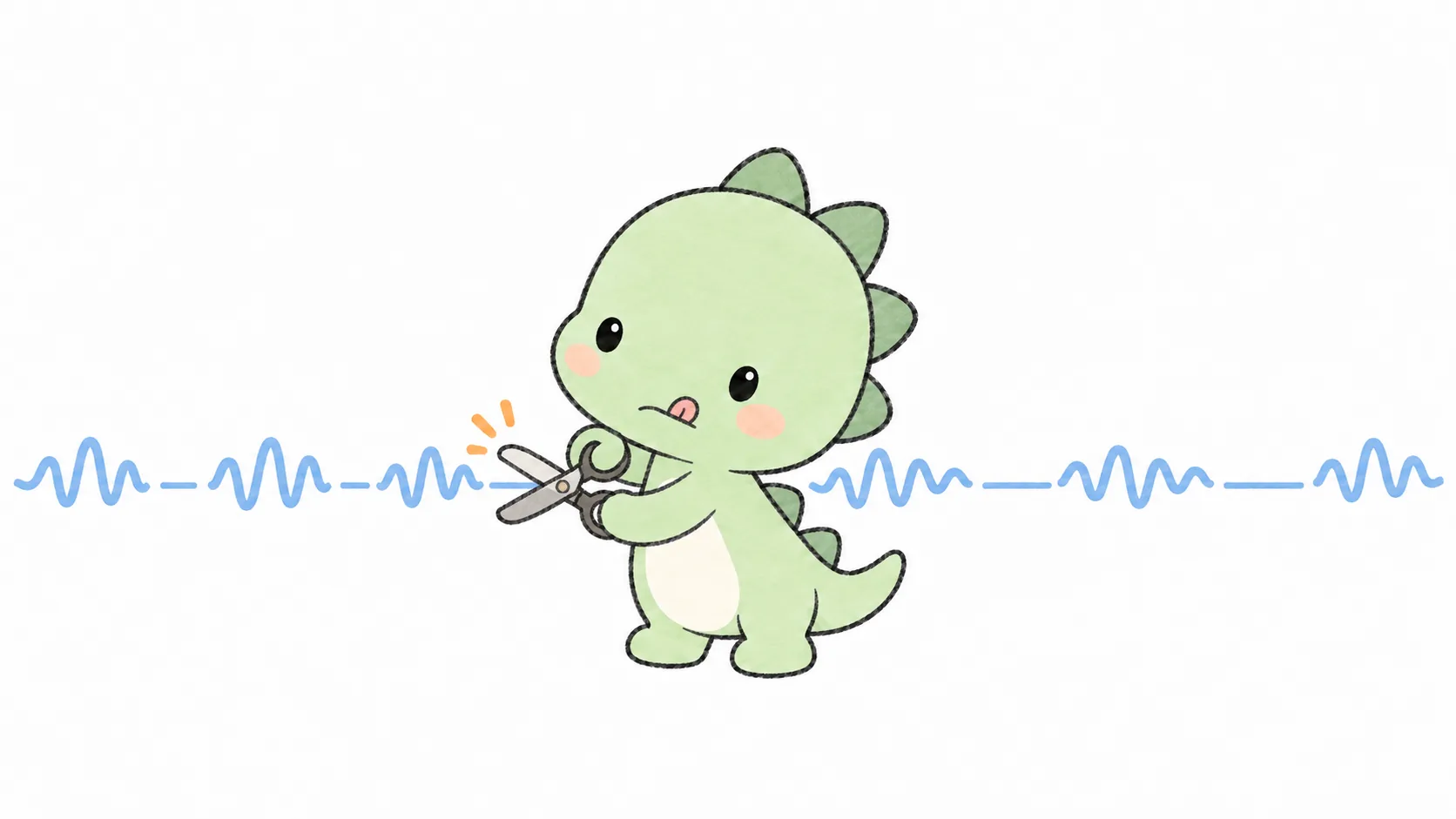
How does Chunk Listening work?
Each sentence has three steps, ten sentences to a session.
Step 1: Hear it in groups. The sentence plays in its meaning groups, two to five of them, with a pause of about a second between each. The screen shows only a row of segments that light up in turn, and no English. Your only job is to listen for where each group ends.
Step 2: Understand it in order. One group plays, then stops. For the important groups you're asked what you just heard, from three meanings, in Traditional Chinese for now. One of the two wrong ones comes from a version that sounds almost the same:
- at nine thirty against at five thirty
- thirteen boxes against thirty boxes
- on Tuesday against on Thursday
- the deadline moved against the headline moved
Here's the first pair. The first clip is the real piece from the example sentence, the second is the wrong option:
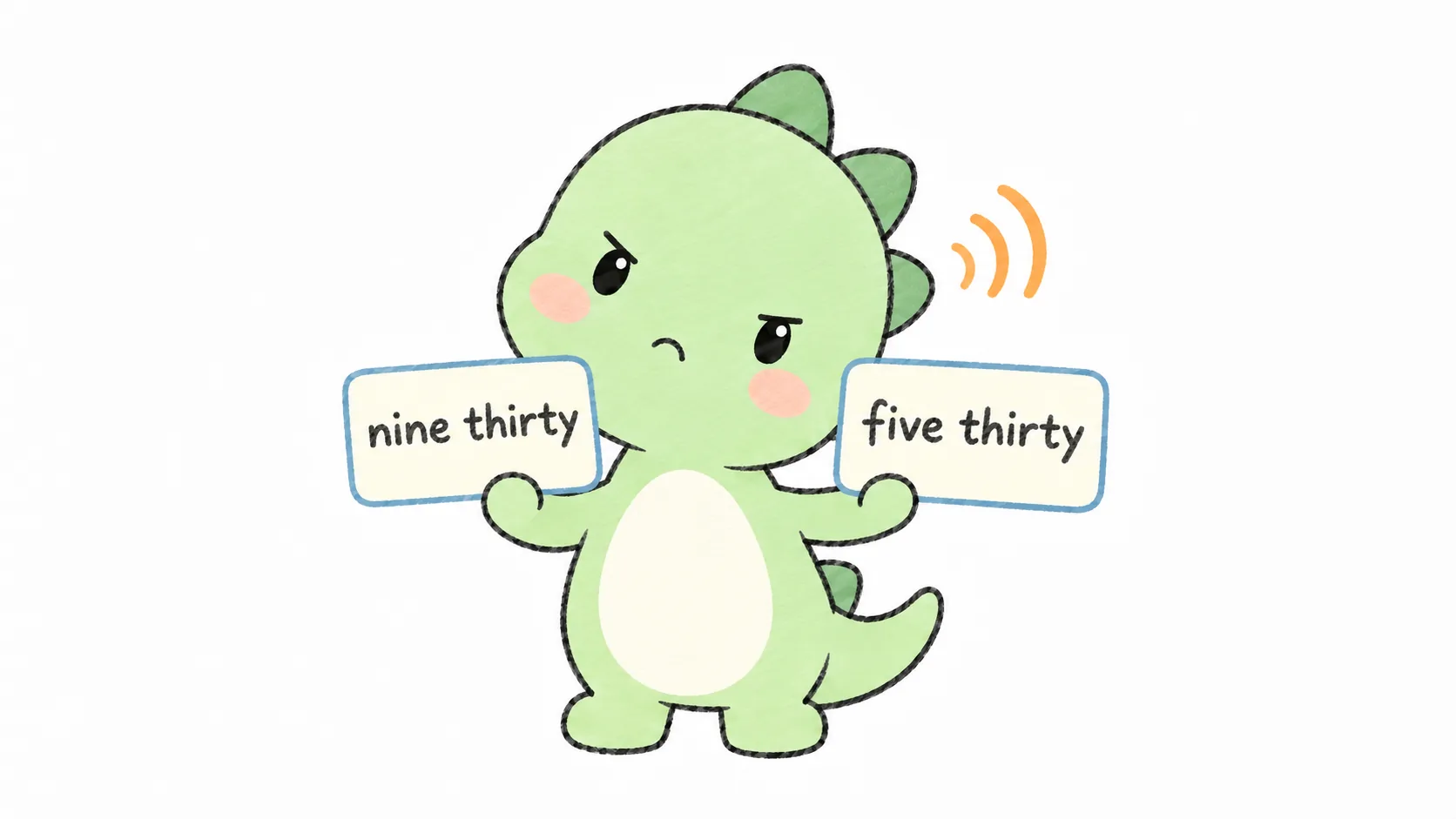
Wrong options that only differ in topic aren't enough. If the choice were "at nine thirty" against "going to lunch," you wouldn't need to listen at all. The thing being trained is the ear, so every question has one wrong option that is the one your ear might really mishear. It isn't an academic point, either: a caterer who hears thirty eight guests as twenty eight leaves ten people in the meeting room staring at empty plates.
The meanings of the groups you've answered stack up on screen in order, so you read them in English word order. That order is the point of the exercise: understanding moves forward with the sound, without waiting for the end of the sentence to translate backwards.
Step 3: Natural speed. The whole sentence plays once, with no pauses. You rebuild it from the groups you just heard, mixed with sound-alike fakes. It plays at normal speed by default; for more of a challenge, this step can play at 1.1× or 1.25×, and the app remembers your choice. The pauses in the first two steps always stay at normal speed, because that's where you learn to split. After hearing it in groups, try it at 1.25×. It's less of a blur than it was at the start:
(All the clips in this post are the audio the app actually plays, which is Azure synthetic speech, not a human recording. The "five thirty" clip was synthesised separately for this post.) Once you've rebuilt the sentence, one tap takes the same sentence into Shadowing, so you can say the groups you just split out.
There are 180 sentences in three lengths: 6–8, 9–12 and 13–16 words. Each session puts the sentences you've practised least first; among those practised equally often, the ones you did worst on come first. A sentence you didn't get fully right goes into the Mistakes notebook to practise again. Sessions count toward your daily goal and streak like any other practice.
A few things to be clear about
- Blau's pauses weren't placed at meaning boundaries. She paused roughly every twenty-odd words. That a pause at the end of a meaning works better is a reasonable inference, but we couldn't find a study that compares pause positions directly.
- Where to split is a human decision. We split where a fluent reader would take a breath and the meaning is complete. Two people splitting the same sentence sometimes differ by a prepositional phrase. What we require is that no split breaks the rules (never separating an article from its noun, for example), not that there's only one right way.
- The pauses aren't like the test. Real TOEIC audio doesn't wait for you, which is why step 3 always plays the whole sentence without pauses. If hearing in groups becomes a habit but normal speed still loses you, that's the time to lean on step 3 and less on the first two.
- This trains the speed of understanding, not the sounds. Linking, weak forms and the rest of the "hearing the sounds" problems need Shadowing and dictation. Train the two apart and neither drags the other down.
- This is a BETA. If a group's meaning looks wrong to you, please tell us. We'll look at how many sentences people actually finish and how often their first answer is right before deciding on advanced levels such as longer sentences.
Chunk Listening is in the "New features" section of Handy 990's home screen, marked BETA. For now it's only offered in the iOS and Android app, to learners using it in Traditional Chinese, and it's free. For what makes Part 3 conversations hard in the first place, read What makes Part 3 difficult; the reading-side version of the same question, how much you take in at once, is in Can learning speed reading save my reading section?.