All articles · Published 2026-09-07
TOEIC Apps vs. Books and Ebooks: Which One Adapts Your Study Plan?
A good TOEIC app can offer a book's complete lessons, examples, and explanations, then adapt your study plan to your performance, goals, and available time. Paper still has practical advantages: fewer digital distractions, more room than a phone screen, and easy handwritten notes. Here is how the learning tools and reading experience compare—and why an app should try to understand what you need.
Imagine two people buying the same TOEIC practice book. Today, both reach page 84. One gets nine out of ten questions right. The other gets nine wrong.
Tomorrow, they both turn to page 85.
The book has done nothing wrong. It delivers the course its author arranged. You decide whether to go back, skip a chapter, or work on vocabulary. You can stick so many colorful notes around the edges that the book grows a rainbow mane. But it will never look at those notes and rearrange tomorrow evening's work for you.
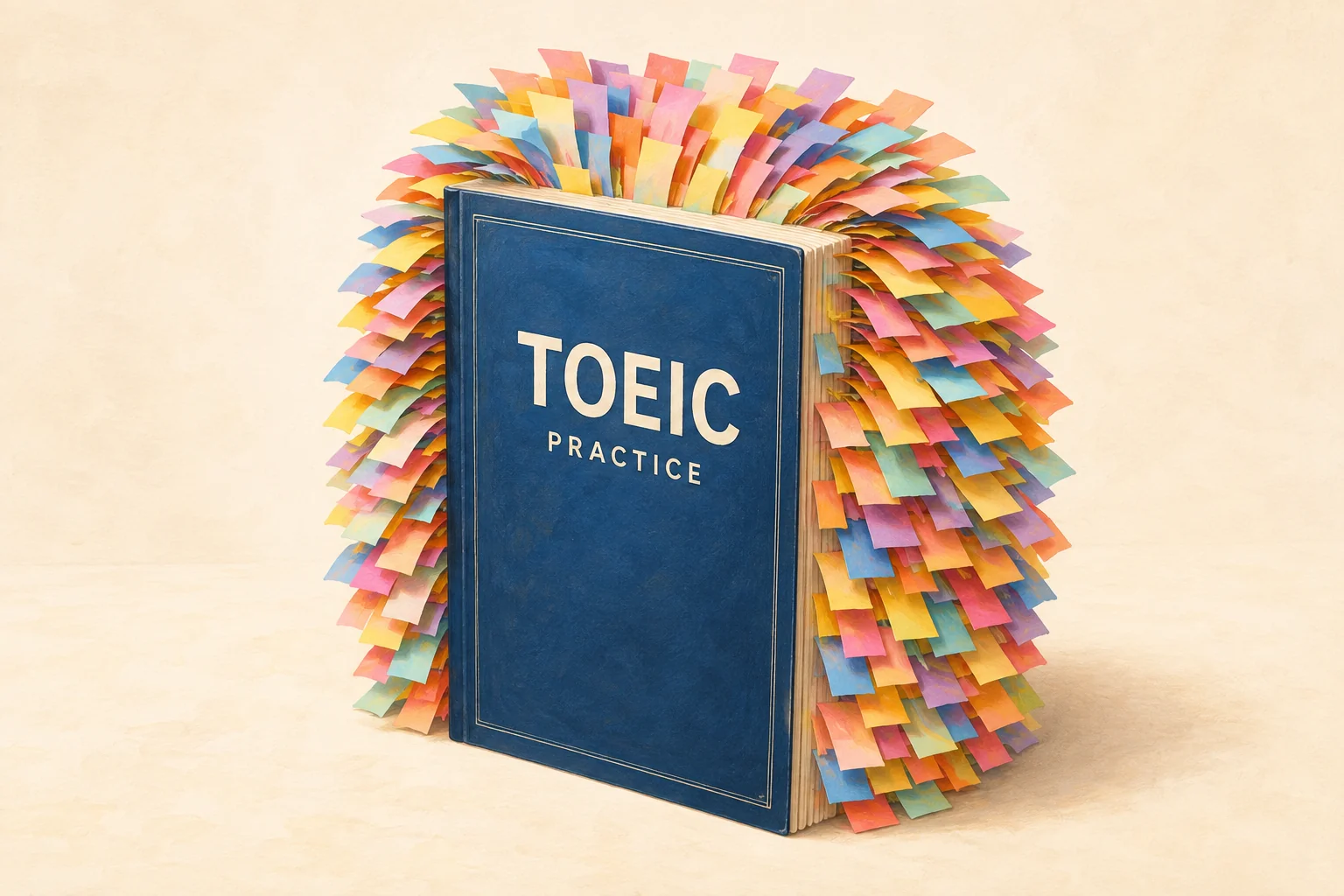
A good app can include everything a good book teaches, then go a step further: try to understand what you need from your performance and propose a plan that fits you better.
“Try” matters. An app cannot read your mind or guarantee the most effective study method in the world. It can record, estimate, recommend, and revise its suggestions as new results come in. That ability to keep responding to you is the most useful distinction between these tools.
Can an app provide everything a good textbook teaches?
Yes. Complete grammar chapters, carefully sequenced examples, strategies for each question type, long reading passages, answer explanations: none of these needs to be printed on paper to be taught clearly. A good app can preserve their depth and structure while also providing search, bookmarks, highlighting, and notes.
If an app offers only disconnected questions and no complete lessons, that is a choice made by that particular product. It does not establish a rule that you need books to learn concepts and apps only to drill them. An app can serve as both your textbook and your practice system.
The comparison below describes what each tool can provide. It does not mean every app already implements every feature well. By “ordinary ebook,” we mean a PDF, EPUB, or other reading material whose content is largely fixed.
| What you want to do | Paper book | Ordinary ebook | App with personalization |
|---|---|---|---|
| Learn grammar and question strategies thoroughly | Can organize complete lessons into chapters | Can preserve the same lessons and chapter structure | Can provide the same complete lessons and connect them to relevant practice |
| Answer questions and read explanations | Can include questions, answers, and detailed explanations | Can provide the same content with links between sections | Can provide the same content and automatically record answers and mistakes |
| Highlight and take notes | Circle, mark, add tabs, and write directly on the page | Can support highlighting, bookmarks, and notes, depending on the reader | Can also provide digital annotations and bookmarks |
| Practice listening | Use the accompanying audio and a playback tool | Can link to or embed audio, depending on the material | Can combine audio, answers, line-by-line transcript comparisons, and explanations |
| Decide what to practice today | Follow the printed schedule or adjust it yourself | Follow the course schedule or adjust it yourself | Can make recommendations using recent performance, goals, and available time |
| Decide when to review | Keep track of dates and revisit mistakes yourself | Manage your own marks and review schedule | Can store each item's review state and schedule its next appearance |
You can therefore hold an app to the same standards as a good textbook. Does it explain concepts completely? Are the examples well chosen? Do the explanations actually answer your questions? Complete teaching is a basic capability an app can aspire to provide.
Personalization is worth discussing only when the material is worth learning. Delivering an incorrect explanation at exactly the right time is just being impressively punctual about teaching the wrong thing.
If an ebook is already on my phone, how is an app different?
Ebooks make material easy to access. Search for “relative pronouns” and you can jump straight to the relevant chapter. Working out whether you need to revisit that chapter right now is a separate job.
A reader knowing which page you reached does not mean it knows how much you learned. To change the practice schedule, a system needs results from your answers or recall attempts—and it needs to use those results when planning the next session.
So putting a book inside an app does not automatically create personalized learning. If everyone gets the same next set of questions, it is still a fixed course. Conversely, an “interactive ebook” that records answers, estimates weaknesses, and reschedules reviews already has the capabilities we mean here. What matters is how it responds to your learning results.
What practical advantages do paper books still have?
For someone preparing for TOEIC on a phone, paper offers several straightforward conveniences worth keeping.
First, one less doorway into social media and games. A paper practice book cannot pop up notifications or let you swipe into short videos. If your phone is beside you, of course you can still pick it up. But putting it out of reach and leaving just the book and a pen means your reading tool no longer doubles as an entertainment portal. That is a real advantage when setting up a place to concentrate.
Second, the page is usually larger than a phone screen. An open practice book has room for passages, questions, and margins at the same time. It also makes it convenient to compare multiple texts in Part 7. Enlarge the text on a phone and less content fits on the screen. If the phone feels cramped or its small text is hard to read, a larger printed page may be more comfortable.
This is about reading space and comfort. It does not establish that paper is always healthier for your eyes. A printed book can have tiny type, too. An app with good layout, tablet support, and larger text options can also improve the reading experience. The size difference between a book and a phone is not an uncrossable boundary between books and software.
Third, handwritten annotation is immediate. Pick up a pen and circle a word, draw an arrow between two sentences, or write your interpretation in the margin. You do not have to select text, open a menu, and decide whether to highlight or add a note. The whole page is available as a place to think.
Ebooks and apps can both provide annotation tools, and a tablet with stylus support can make handwriting feel natural. Still, a paper book and a pen are all you need to get started. That convenience remains. Offering the same function digitally does not mean using it feels equally effortless on every device.
How should a good TOEIC app understand what you need?
Imagine two learners who both scored 600 on their most recent TOEIC test, both want 800, and both have 30 minutes a day. This is a hypothetical example to explain the design.
The first learner has relatively steady listening skills but a substantial reading gap, especially in Part 5. The second is relatively comfortable with reading but often struggles to keep up with Parts 3 and 4.
Handing both of them the same “study plan for a 600 scorer” uses only one clue: the total score. Include their performance and goals for each Part, and there is a reason to give the first learner more reading work and the second more listening. If their performance changes later, the allocation should change, too.
In software terms, that requires an ongoing feedback process:
- Record what you did. Which questions you answered, whether you got them right, and which words you could not recall. Let you set goals and available study time as inputs to the plan.
- Estimate what you currently need. Combine multiple results into a provisional picture of your ability. Distinguish areas still far from your goal from areas that can move to lighter maintenance practice.
- Turn that estimate into a next step. Within your time limit, suggest specific question counts, areas to practice, and items to review.
- Update from new results. Once you finish, add the latest performance to the record so future recommendations can change.
Stop at the second step and the system can give you a beautiful chart of your weaknesses, but you still have to decide what to study tonight. Connect the third and fourth steps, and measurement begins to guide your preparation.
A paper book can include a placement test or say, “If you missed three or more questions here, review chapter two.” That is useful guidance. You can also use it to maintain an excellent personal schedule manually. The difference is that the book itself will not keep updating its estimate of you or automatically turn all your new results into a revised plan. You, a teacher, or another tool must do that work.
What has Handy 990 actually connected?
Handy 990's grammar module includes explanations and exercises organized by topic. Each Part offers a “Strategy guide,” and questions have accompanying explanations. These are teaching resources we already provide. The complete lessons and range of digital annotation tools discussed above are standards for evaluating a good app; they do not mean we have implemented every one of those capabilities.
Alongside those teaching resources, we have built several specific ways to adjust practice using your records.
Smart Practice allocates time using performance in each Part. When you have targets for individual Parts, the allocation considers the gap between your current accuracy and your target, together with that Part's share of the questions on the exam. Without targets, it uses your current strengths and weaknesses. With neither targets nor answer history, it starts from the exam's question proportions. Parts where you have already met your target retain a maintenance weight, making room for both improvement and upkeep.
The plan reserves time to review explanations. Smart Practice multiplies each question's estimated answering time by 2, reserving another portion for reading explanations and understanding mistakes. This is a scheduling assumption. Your actual time depends on you and the questions. You can also adjust the time budget and the number of questions or question sets in each Part.
Today's tasks consider your preparation status. The home screen uses information such as days until your test, available daily study time, rest days, outstanding mistakes, and reviews that are due to assemble the day's tasks. It gives you a starting point you can act on, reducing the work of planning a fresh lesson every time you open the app.
Vocabulary and phrases have their own review schedule. Smart Review uses FSRS to store review states and calculate the next due date from recall performance and elapsed time. Words at different levels of familiarity can therefore follow different review schedules.
These features all put the records you leave behind to work in your next session. For how time is divided and how short sessions preserve complete question sets, read How Handy 990 Decides What You Should Practice Today. The vocabulary system is explained in How to Learn TOEIC Vocabulary.
The core of Smart Practice consists of explicit rules and calculations. Personalization does not first require a conversational AI. It requires reliable records and a plan that actually changes in response to them.
Which learning designs does the research support?
An app can carry a book's lessons and add automatic recording and scheduling. Making that functional advantage useful still takes good teaching design.
Dunlosky and colleagues (2013, Psychological Science in the Public Interest) reviewed the evidence for 10 common learning techniques and rated practice testing and distributed practice as highly useful. In practical study terms, that means making time to recall information and answer questions, and spreading practice across different occasions.
You can do this on paper: cover the answers, test yourself, and return a few days later. An app can go further by managing each item's answer history and review schedule, making these methods part of a routine. That is a design implication we draw from the research. The research itself did not establish how many TOEIC points a particular app's schedule will add.
There is also evidence worth taking seriously about paper. Delgado, Vargas, Ackerman, and Salmerón (2018, Educational Research Review) combined 54 studies from 2000–2017 comparing reading comprehension for similar texts on paper and screens. They found a small overall advantage for paper, with a larger advantage under time pressure.
That reminds us that even with the same content, the reading experience can differ. However, the research focused on comparable linear reading material. It did not compare complete personalized test-preparation systems, and the observed differences cannot all be attributed to notifications or screen size.
For app developers, these two studies set the same assignment: build in effective practice methods and make the reading interface work well. More features still have to result in something people can comfortably read and practice with.
How should you choose your main TOEIC study tool?
If an app has complete lessons, reliable explanations, comfortable reading, and practice that responds to your situation, it can serve as your main study tool. You need not start from the assumption that learning concepts requires buying a separate book.
First inspect the material. Then read a long passage and an explanation yourself. Finally, check whether the plan uses your own records. Does the recommendation change when you change your goal or available time? Do new results affect what comes next? Those questions tell you more than counting how many times “smart” appears on the home screen.
If picking up your phone leads straight to distraction, or you prefer large pages and handwritten notes, paper has concrete advantages. Choose it because that way of working suits you. You can also leave listening and short practice sessions to your phone and use paper for longer reading.
If you have already found an excellent ebook and have a schedule and review method that work, you can keep using them. A dedicated reader may also offer a simpler reading environment. The key is knowing who will handle the records and adjustments beyond the fixed material.
Finally, if you are taking a paper-based test, schedule timed practice with a paper booklet and answer sheet to become familiar with turning pages, cross-referencing, and filling in answers. Everyday skill work and rehearsing the test format can use different tools.
An honest caveat: an app can recommend a plan, not guarantee the best one
“Understanding you” always means estimating from limited information. A wrong answer might reflect a missing concept or simply a word you overlooked. A correct answer might be a guess. A small set of responses cannot establish your true weaknesses, let alone guarantee which allocation will produce the greatest improvement.
Handy 990's Smart Practice primarily distributes work among Parts. We cannot claim it automatically identifies the cause of every mistake and prescribes the single correct remedy. Questions you do in a book, lessons from a class, and how tired you feel today also do not automatically appear in its records in full.
A good plan should therefore be understandable, adjustable, and open to revision as more evidence arrives. “Best for you” is a direction to keep working toward and to check against later performance.
The book with the rainbow mane can still be a study tool you love. But we can expect a good app to include a good book's complete teaching and add a job the book cannot do automatically: keep learning from your records and answer, given your performance, goals, and available time, what is most worth doing first today?
On the Handy 990 home screen, you can view today's tasks and open Smart Practice. Vocabulary and phrase flashcard screens offer Smart Review. See How Handy 990 Decides What You Should Practice Today for the allocation rules, and How to Learn TOEIC Vocabulary for the memory and review design.